
DMA Testing Service – Dynamic Mechanical Analysis for Viscoelastic and Dynamic Mechanical Properties
Shanghai Jituo Material Technology Co., Ltd. provides professional Dynamic Mechanical Analysis (DMA) testing services for polymers, chemical materials, inorganic ceramics, metals, composite materials, specialty chemicals and biomaterials.
DMA evaluates the deformation response of materials under periodic dynamic loading as a function of temperature, frequency or time. It provides key parameters such as storage modulus (E'), loss modulus (E'') and Tan Delta, supporting the characterization of glass transition temperature (Tg), damping behavior, mechanical relaxation and temperature-dependent mechanical properties.
Jituo Tech uses a TA Instruments Q850 Dynamic Mechanical Analyzer. Different testing modes can be selected according to sample characteristics and testing objectives, providing analytical support for material development, formulation optimization, performance evaluation and quality control.
1. Overview of DMA Testing Services
Dynamic Mechanical Analysis (DMA) is an important technique for studying the dynamic mechanical properties and viscoelastic behavior of materials. It is particularly useful for polymers, rubber, elastomers, thermosetting resins, adhesives and fiber-reinforced composites.
Unlike conventional static mechanical testing, DMA measures the mechanical response of materials under oscillating stress or strain. By combining dynamic loading with controlled temperature, frequency or time conditions, DMA characterizes the elastic and viscous behavior of materials.
Main DMA testing services at Jituo Tech include:
| Testing Item | Measurement | Application Value |
|---|---|---|
| Glass Transition Temperature (Tg) | Glass transition region and characteristic temperatures | Evaluation of thermomechanical performance and operating temperature |
| Storage Modulus (E') | Dynamic elastic response | Evaluation of stiffness and resistance to deformation |
| Loss Modulus (E'') | Dynamic energy dissipation | Evaluation of viscous response and energy loss |
| Tan Delta | Ratio of loss modulus to storage modulus | Evaluation of damping and vibration-dissipation properties |
| Temperature Sweep | Changes in modulus and Tan Delta with temperature | Investigation of temperature-dependent properties |
| Frequency Sweep | Changes in dynamic mechanical parameters with frequency | Investigation of frequency-dependent behavior |
| Time Sweep | Dynamic mechanical response over time | Evaluation of dynamic stability and relaxation behavior |
Our DMA testing services are suitable for:
- Polymer material manufacturers and R&D teams
- Rubber, elastomer and vibration-damping material manufacturers
- Epoxy resin and thermosetting material developers
- Adhesive, coating and functional film manufacturers
- Carbon fiber, glass fiber and composite material developers
- Universities, research institutes and third-party testing customers
- Corporate R&D, process engineering and quality control departments
2. What Is Dynamic Mechanical Analysis (DMA)?
Dynamic Mechanical Analysis (DMA) is a technique used to study the dynamic mechanical properties of materials by measuring their deformation response under oscillating loads.
During DMA testing, a periodic stress or strain is applied to a specimen at a defined frequency and amplitude. Temperature or time is controlled according to a predefined program, and the material's mechanical response is measured.
For viscoelastic materials, strain generally lags behind the applied stress by a phase angle. Analysis of stress, strain and phase angle provides storage modulus, loss modulus and Tan Delta.
2.1 Storage Modulus (E')
Storage modulus represents the ability of a material to store elastic energy during dynamic deformation. It mainly reflects the elastic response and stiffness of the material. A higher storage modulus generally indicates greater resistance to dynamic deformation under the specified testing conditions.
2.2 Loss Modulus (E'')
Loss modulus represents the ability of a material to dissipate mechanical energy during dynamic deformation through internal friction and other energy-dissipation mechanisms.
It is used to characterize the viscous response and energy-dissipation behavior of materials.
2.3 Tan Delta (Tanδ)
Tan Delta is the ratio of loss modulus to storage modulus:
Tan Delta = E'' / E'
Tan Delta represents the relative proportion of energy dissipation to energy storage during dynamic deformation. It is an important parameter for evaluating damping performance and viscoelastic behavior.
2.4 Glass Transition Temperature (Tg)
When a polymer transitions from a glassy state to a rubbery state, its molecular mobility and dynamic mechanical properties change significantly.
DMA can characterize the glass transition by analyzing changes in storage modulus, loss modulus and Tan Delta during heating.
DMA Tg may differ from DSC Tg because the measurement principles and determination methods are different. DMA Tg is affected by testing frequency, heating rate, fixture mode, applied force and the selected determination method. Results should therefore be interpreted in the context of the actual testing conditions.
3. What Properties Can Be Measured by DMA? Typical Applications
DMA measures dynamic mechanical properties as a function of temperature, frequency or time. Its main applications include characterization of elasticity, viscous response, damping and glass transition behavior.
| Property | Main Data | Typical Applications |
|---|---|---|
| Glass Transition Temperature | Tg and transition region | Thermal performance evaluation of epoxy resins, plastics and composites |
| Storage Modulus | E' versus temperature or frequency | Stiffness and elastic property analysis |
| Loss Modulus | E'' versus temperature or frequency | Viscous response and energy-dissipation analysis |
| Tan Delta | Tan Delta curve and peak | Evaluation of rubber, vibration-damping and damping materials |
| Temperature Dependence | E', E'' and Tan Delta versus temperature | Evaluation of operating temperature and thermomechanical behavior |
| Frequency Dependence | Dynamic modulus at different frequencies | Simulation of dynamic loading and service conditions |
| Mechanical Relaxation | Dynamic response over time | Study of polymer viscoelasticity and relaxation behavior |
Typical Application 1: Glass Transition Analysis of Polymer Materials
Temperature-sweep DMA testing provides storage modulus, loss modulus and Tan Delta curves, allowing the analysis of dynamic mechanical changes during the transition from the glassy state to the rubbery state.
Typical materials include:
- Epoxy resins and cured thermosetting resins
- Engineering plastics and high-performance polymers
- Polyurethane and elastomers
- Polymer composites
Typical Application 2: Damping Performance Evaluation of Rubber and Elastomers
Changes in Tan Delta and loss modulus with temperature or frequency can be used to evaluate the dynamic energy-dissipation capability and damping characteristics of rubber materials.
Typical materials include:
- Natural rubber
- Silicone rubber
- Nitrile rubber
- Polyurethane elastomers
- EVA and other elastomers
Typical Application 3: Dynamic Mechanical Analysis of Composite Materials
Suitable bending or other fixture modes can be used to characterize dynamic modulus, temperature response and glass transition behavior of fiber-reinforced composites.
Typical materials include:
- Carbon fiber-reinforced polymer composites
- Glass fiber-reinforced composites
- Epoxy-based composites
- Other composite materials with suitable dimensions and mechanical properties
Typical Application 4: Viscoelastic Evaluation of Adhesives and Coatings
DMA can investigate the mechanical response of adhesives, polymer coatings and functional films at different temperatures and frequencies, supporting formulation optimization and application performance evaluation.
4. Which Materials Can Be Tested by DMA?
DMA is mainly suitable for solid materials with sufficient mechanical integrity to meet the requirements of the selected fixture. The appropriate testing mode depends on sample geometry, dimensions, stiffness and thermal stability.
| Material Category | Typical Materials | Main Testing Objectives |
|---|---|---|
| Plastics and Polymers | PE, PP, PVC, PS, PC, PA and PET | Tg, storage modulus and loss modulus |
| Rubber and Elastomers | Natural rubber, silicone rubber, nitrile rubber, EVA and polyurethane | Tan Delta, damping and dynamic modulus |
| Thermosetting Resins | Epoxy, phenolic and unsaturated polyester resins | Tg and dynamic mechanical properties |
| Adhesives | Epoxy adhesives, structural adhesives and pressure-sensitive adhesives | Viscoelasticity, temperature response and Tg |
| Composite Materials | Carbon fiber and glass fiber composites | Dynamic modulus, Tg and temperature dependence |
| Coatings and Films | Polymer coatings and functional films | Viscoelasticity and temperature-dependent properties |
| Biomaterials | Selected polymer-based biomaterials and hydrogels | Dynamic mechanical response |
| Inorganic Materials | Selected ceramics and other inorganic materials | Subject to brittleness, dimensions and fixture evaluation |
| Metals | Selected metals and metal-matrix composites | Subject to testing mode and instrument suitability |
| Specialty Chemicals | Suitable solid polymeric materials and related products | Feasibility depends on sample condition |
Important: Not all materials can be tested directly by DMA. Powders, liquids, brittle ceramics, irregular specimens and materials that soften, melt or decompose within the testing temperature range require preliminary feasibility evaluation.
5. DMA Instrument Model
Instrument Model: TA Instruments Q850 Dynamic Mechanical Analyzer
Shanghai Jituo Material Technology uses the Q850 Dynamic Mechanical Analyzer manufactured by TA Instruments, USA.
Different fixture modes can be selected according to sample dimensions, material stiffness and testing objectives.
Main testing modes include:
- Tension: Suitable for specimens that can be prepared as strips, for evaluating dynamic mechanical properties in the tensile direction.
- Three-Point Bending: Suitable for relatively rigid plate-like or strip specimens, for evaluating flexural dynamic modulus.
- Single Cantilever: Measures dynamic mechanical response through cantilever bending.
- Dual Cantilever: Performs dynamic bending tests using a double-clamped specimen configuration.
- Shear: Suitable for selected soft rubber and elastomer specimens, for evaluating shear modulus and viscoelastic behavior.
The actual testing mode depends on fixture configuration, sample dimensions and testing conditions.
6. DMA Instrument Technical Specifications
| Parameter | Specification |
|---|---|
| Instrument Model | TA Instruments Q850 |
| Temperature Range | -100 to 500°C (as listed on the original English page) |
| Temperature Accuracy | ±0.01°C |
| Heating Rate | 0.1 to 50°C/min |
| Frequency Range | 0.1 to 100 Hz |
| Test Atmosphere | Air |
Specification note: The current Chinese and English website pages show different temperature ranges. The Chinese page lists -100 to 450°C, while the English page lists -100 to 500°C. The actual operating range should be confirmed with the laboratory and unified across both language versions before publication.
7. DMA Sample Requirements
DMA testing requires suitable sample dimensions, geometry and mechanical integrity. Different fixture modes have different specimen requirements.
7.1 Recommended Sample Dimensions
| Testing Mode | Sample Length | Sample Width | Sample Thickness |
|---|---|---|---|
| Tension | 30–50 mm | 5–10 mm | 0.5–2 mm |
| Three-Point Bending | 50–55 mm | 5–10 mm | 1–2 mm |
| Single/Dual Cantilever | 35–55 mm | 5–10 mm | 1–2 mm |
| Shear | 40–45 mm | 5–10 mm | 1–3 mm |
Note: These dimensions are based on the current English service page. Actual specimen requirements should be confirmed with the laboratory because they may vary with fixture configuration and sample conditions.
7.2 Sample Preparation Requirements
- Prepare 2–3 specimen strips that meet the requirements of the selected testing mode.
- Specimens should have uniform dimensions and smooth surfaces, without obvious cracks, bubbles or defects.
- Samples should have sufficient mechanical integrity for secure fixture mounting.
- Samples should not undergo severe decomposition, softening or melting within the intended testing temperature range, as this may affect results or damage the instrument.
- For special geometries, films, powders or irregular specimens, please provide sample photographs and dimensions in advance.
- For temperature-sensitive materials, provide thermal stability information or the intended testing temperature range before submission.
7.3 Information Recommended Before Sample Submission
To develop an appropriate DMA testing plan, please provide:
- Sample name and material type.
- Sample dimensions, geometry and quantity.
- Intended testing temperature range.
- Main testing objective, such as Tg, storage modulus, loss modulus or Tan Delta.
- Any specified testing standards or comparison samples.
8. DMA Testing Procedure
Shanghai Jituo Material Technology develops DMA testing plans according to the material type, sample condition and testing objectives.
Standard DMA testing workflow:
- Submit Testing Requirements: Provide material information, sample dimensions and testing objectives.
- Confirm Testing Plan: The laboratory evaluates the material type, testing items and expected results.
- Evaluate Sample Suitability: Check sample dimensions, geometry, mechanical integrity and thermal stability.
- Select Testing Mode: Choose tension, three-point bending, single/dual cantilever or shear mode.
- Set Testing Parameters: Determine temperature range, heating rate, frequency and other conditions.
- Perform DMA Testing: Conduct testing using the TA Q850 Dynamic Mechanical Analyzer.
- Collect Data: Obtain storage modulus, loss modulus and Tan Delta curves.
- Analyze Results: Evaluate Tg, dynamic modulus and viscoelastic characteristics according to the testing objectives.
- Deliver Report: Organize the testing data and provide the report according to the agreed deliverables.
DMA Testing Workflow Diagram

9. DMA Testing Standards
The following international and national standards may be considered according to the material type, testing mode and customer requirements.
| Standard | Standard Name or Application |
|---|---|
| ASTM D4065 | Practices for dynamic mechanical properties of plastics |
| ASTM D5023 | Dynamic mechanical properties of plastics in flexure |
| ASTM D5418 | Test method related to dynamic mechanical properties of plastics |
| ASTM D7028 | DMA determination of glass transition temperature of polymer-matrix composites |
| ISO 6721-1 | Plastics — Determination of dynamic mechanical properties — Part 1: General principles |
| ISO 6721-5 | Plastics — Determination of dynamic mechanical properties — Part 5: Flexural vibration |
| ISO 4664-1 | Rubber — Determination of dynamic properties — Part 1: General guidance |
| GB/T 33061.1-2016 | Plastics — Determination of dynamic mechanical properties — Part 1: General principles |
| GB/T 33061.5-2020 | Plastics — Determination of dynamic mechanical properties — Part 5: Flexural vibration method |
| GB/T 9870.1-2006 | Rubber — Determination of dynamic properties — Part 1: General principles |
Note: The standards above are listed on the existing service page. Their current validity, material applicability and specific testing modes should be verified before testing. The final standard should be confirmed in the agreed testing plan.
10. DMA vs. Other Thermal Analysis Techniques
DMA, DSC, TGA and TMA are commonly used thermal analysis techniques, but they are based on different measurement principles and evaluate different material properties.
| Instrument | Full Name | Core Measurement | Main Applications |
|---|---|---|---|
| DMA | Dynamic Mechanical Analyzer | Storage modulus, loss modulus, Tan Delta and dynamic mechanical properties | Viscoelasticity, damping and dynamic modulus |
| DSC | Differential Scanning Calorimeter | Heat flow, melting, crystallization, glass transition and enthalpy | Thermal transitions and thermal effects |
| TGA | Thermogravimetric Analyzer | Mass changes as a function of temperature or time | Thermal decomposition, thermal stability and residue analysis |
| TMA | Thermomechanical Analyzer | Dimensional changes and deformation under temperature variation | Thermal expansion, softening and dimensional stability |
What Is the Difference Between DMA and DSC?
DSC measures the heat flow difference between a sample and a reference to investigate glass transition, melting, crystallization and curing-related thermal effects.DSC test
DMA applies dynamic mechanical loading and measures the material's mechanical response to obtain storage modulus, loss modulus and Tan Delta.
Both techniques can investigate glass transition behavior, but their measurement principles and Tg determination criteria differ. DMA is particularly useful for studying dynamic stiffness, damping and viscoelasticity, while DSC is more suitable for investigating melting, crystallization and curing heat effects.
What Is the Difference Between DMA and TGA?
TGA measures changes in sample mass during heating or isothermal conditions. It is used to analyze decomposition temperature, thermal stability, volatile content and residue.TGA test
DMA focuses on dynamic mechanical properties and viscoelastic behavior.
What Is the Difference Between DMA and TMA?
TMA measures dimensional changes or deformation under a controlled temperature program. It is used to evaluate the coefficient of thermal expansion, softening and dimensional stability.
DMA focuses on storage modulus, loss modulus and damping behavior under dynamic loading.
11. DMA Testing Cases
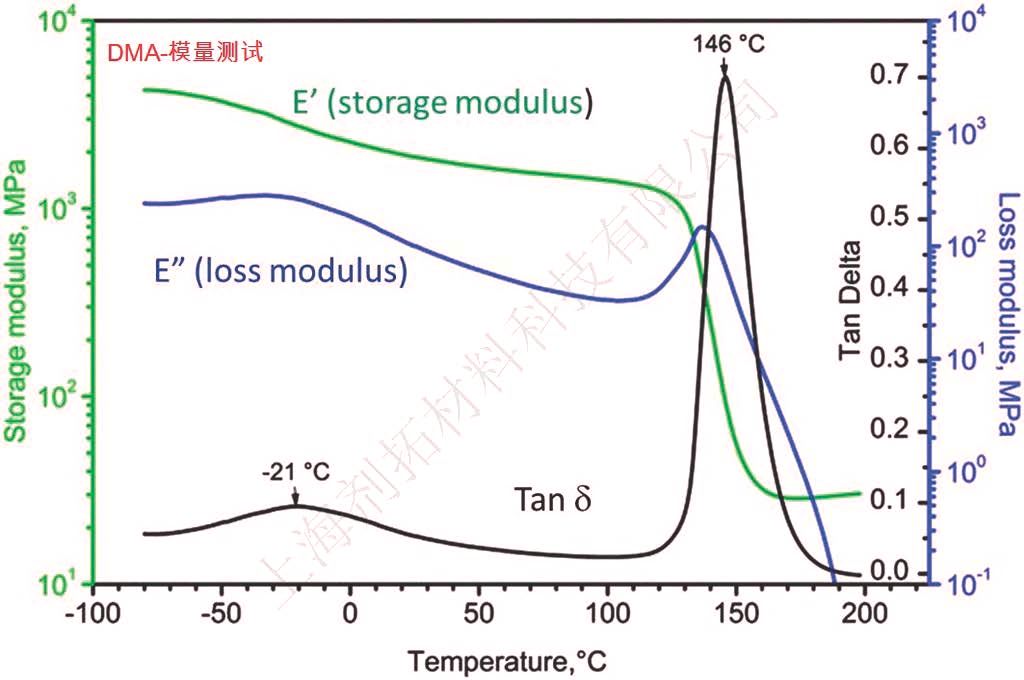
Case disclosure note: The current Jituo Tech DMA service page publicly displays a modulus testing curve and a glass transition testing curve. The first two cases below are based on information identifiable from these published graphs. Sample identities, customer details and complete experimental conditions have not been disclosed and are therefore not inferred. The third case is provided as a real-project information template and should not be published as a completed customer case until the original experimental records are available.
Case 1: Dynamic Modulus and Loss Factor Testing
Test Object: The sample represented in the DMA modulus testing graph published on the website. The original page does not disclose the specific material or customer information.
Testing Objectives:
- Analyze the variation of storage modulus with temperature.
- Investigate loss modulus and energy-dissipation behavior.
- Examine damping and transition characteristics using the Tan Delta curve.
Testing Method: Dynamic Mechanical Analysis with temperature scanning, monitoring storage modulus, loss modulus and Tan Delta. The exact frequency, heating rate, fixture mode and specimen dimensions should be confirmed from the original experimental records.
Data and Curves Obtained:
- Storage modulus E' versus temperature.
- Loss modulus E'' versus temperature.
- Tan Delta versus temperature.
- The published graph marks a main Tan Delta peak at approximately 146°C, as well as a lower-temperature feature near -21°C.
Application Value: This type of testing can be used to analyze dynamic stiffness, energy dissipation and damping behavior as a function of temperature, supporting material formulation and operating-temperature evaluation.
Case 2: DMA Glass Transition Temperature Testing
Test Object: The sample represented in the DMA glass transition testing graph published on the website. The original page does not disclose the specific material or customer information.
Testing Objectives:
- Investigate dynamic mechanical changes in the glass transition region.
- Analyze characteristic changes in storage modulus, loss modulus and Tan Delta.
- Use different curve features to support Tg evaluation.
Testing Method: DMA temperature-sweep testing to obtain storage modulus, loss modulus and Tan Delta curves. The exact frequency, heating rate, fixture mode and specimen dimensions should be confirmed from the original experimental records.
Data and Curves Obtained:
The published graph marks the following characteristic temperatures:
| Curve Feature | Temperature Marked on the Graph |
|---|---|
| Storage modulus curve feature | 155.14°C |
| Loss modulus curve feature | 156.44°C |
| Tan Delta peak | 160.27°C |
These are the temperatures marked on the published graph. Without the original test report and determination criteria, they should not be treated as interchangeable Tg values.
Application Value: By comparing the storage modulus drop, loss modulus feature and Tan Delta peak, the glass transition behavior of a material can be evaluated to support thermal performance and application-temperature assessment.
Case 3: DMA Damping Performance Testing of Rubber or Elastomer Materials
Test Object: A real rubber or elastomer sample to be specified from an actual testing project. The current public website does not provide a verifiable independent project name or corresponding original data curve.
Testing Objectives:
- Evaluate dynamic damping performance at different temperatures.
- Analyze changes in storage modulus, loss modulus and Tan Delta.
- Support rubber formulation optimization and vibration-damping material development.
Testing Method: Select a suitable DMA fixture according to sample dimensions and stiffness, followed by temperature-sweep or frequency-sweep testing. Frequency, heating rate, applied force and sample dimensions should be taken from the actual experimental records.
Data and Curves to Include:
- Storage modulus E' curve.
- Loss modulus E'' curve.
- Tan Delta curve.
- Main damping-related characteristic temperatures and corresponding testing conditions.
- Comparison results between formulations or samples, if available.
Application Value: Comparing Tan Delta and dynamic modulus under different temperature and frequency conditions can help evaluate rubber damping behavior and support the development of vibration-damping, sealing and elastomer formulations.
Information Required Before Publication: This case must be supported by an actual testing record. At minimum, add the sample name, project identifier or test date, testing mode, temperature and frequency conditions, measured data and corresponding graph. Until these details are available, it should not be presented as a completed real customer case.
12. Frequently Asked Questions About DMA Testing
FAQ 1: What Parameters Can DMA Measure? Can DMA Determine Glass Transition Temperature (Tg)?
Yes. DMA is mainly used to measure storage modulus (E'), loss modulus (E''), Tan Delta and glass transition temperature (Tg). It can also characterize dynamic mechanical properties under different temperatures, frequencies and time conditions.
FAQ 2: What Is the Difference Between Tg Measured by DMA and Tg Measured by DSC?
DMA evaluates glass transition through changes in dynamic mechanical properties, while DSC identifies thermal transitions through changes in heat flow. The measurement principles, sensitivities and Tg determination criteria differ, so the results may not be identical. DMA is particularly useful when dynamic stiffness and viscoelastic changes are important.
FAQ 3: How Many Samples Are Required for DMA Testing? What Are the Sample Dimensions?
We generally recommend providing 2–3 specimen strips that meet the fixture requirements. Different testing modes require different dimensions.
For example:
- Tension specimens: 30–50 mm long, 5–10 mm wide and 0.5–2 mm thick.
- Three-point bending specimens: 50–55 mm long, 5–10 mm wide and 1–2 mm thick.
Please confirm the actual requirements with the laboratory before sample submission.
FAQ 4: Can Metals, Ceramics and Composite Materials Be Tested by DMA?
Selected metals, ceramics and composite materials may be suitable for dynamic mechanical testing. Feasibility depends on sample dimensions, stiffness, brittleness, testing temperature and fixture compatibility. Three-point bending may be evaluated for suitable high-stiffness materials. Please provide sample information for preliminary assessment, especially for brittle or irregular specimens.
FAQ 5: What Data and Curves Are Included in a DMA Testing Report? How Long Does Testing Take?
Depending on the agreed testing plan, a DMA report may include sample information, instrument and testing conditions, storage modulus, loss modulus, Tan Delta curves and relevant Tg analysis.


