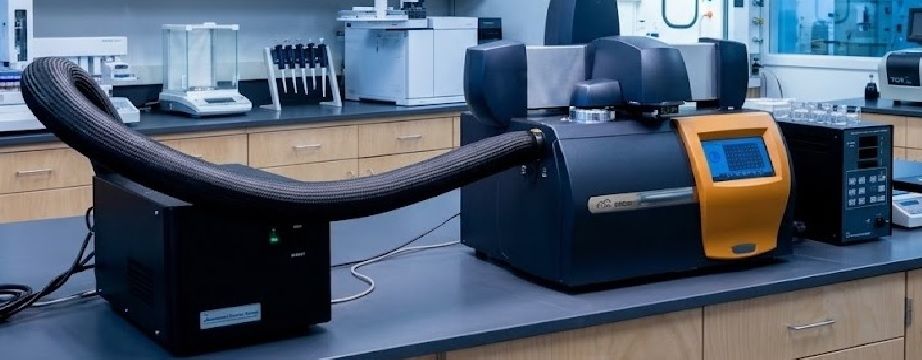
Rotational Rheology Testing Services
Shanghai Jituo Material Technology Co., Ltd. provides professional Rotational Rheology Testing Services for polymers, chemical materials, inorganic ceramics, metals, composite materials, fine chemicals, and biomaterials.We serve material scientists, R&D engineers, university research teams, manufacturing companies, QA/QC departments, R&D managers, and technical procurement professionals.Using a rotational rheometer, we characterize the flow behavior and viscoelastic properties of materials under different shear conditions, oscillation frequencies, temperatures, and time-dependent conditions.
Depending on the testing method, key rheological parameters include:
- Viscosity and apparent viscosity
- Shear stress and shear rate
- Storage modulus (G')
- Loss modulus (G'')
- Complex modulus (G*)
- Complex viscosity (η*)
- Loss factor (Tan δ)
- Yield stress and yield behavior
- Thixotropic properties
- Structural recovery behavior
Overview of Rotational Rheology Testing Services
Rotational rheology testing is a material characterization technique used to investigate the flow behavior and viscoelastic response of materials under controlled shear or oscillatory deformation.Shanghai Jituo offers customized rheological testing solutions based on sample characteristics, research objectives, and application requirements.Our rotational rheology testing capabilities cover the following major techniques:
1. Steady Shear Testing
Steady shear testing investigates the relationship between shear rate, shear stress, and apparent viscosity.It helps determine whether a material exhibits Newtonian or non-Newtonian flow behavior. Typical testing results include:
- Viscosity versus shear rate curves
- Shear stress versus shear rate curves
- Shear-thinning behavior
- Shear-thickening behavior
- Flow behavior and viscosity profiles
2. Dynamic Oscillation Testing
Dynamic oscillatory testing applies periodic deformation or stress to characterize the viscoelastic behavior of materials. Typical parameters include:
- Storage modulus (G')
- Loss modulus (G'')
- Complex modulus (G*)
- Complex viscosity (η*)
- Loss factor (Tan δ)
3. Frequency Sweep Testing
Frequency sweep testing evaluates the viscoelastic response of materials over a range of oscillation frequencies under controlled temperature and within the linear viscoelastic region (LVR).
- Frequency-dependent viscoelastic behavior
- Material relaxation characteristics
- Internal structural properties
- Elastic and viscous contributions
4. Strain Sweep / Amplitude Sweep Testing
Strain sweep testing gradually changes the oscillatory strain or stress to determine the linear viscoelastic region (LVR). It is commonly used to evaluate:
- Linear viscoelastic limits
- Structural stability
- Critical strain
- Structural breakdown under deformation
- Yield-related behavior
5. Temperature Sweep Testing
Temperature sweep testing investigates changes in rheological properties as the sample temperature increases or decreases under controlled conditions. Typical parameters include:
- Storage modulus versus temperature
- Loss modulus versus temperature
- Complex viscosity versus temperature
- Temperature-dependent viscoelastic behavior
- Thermal rheological transitions
6. Time Sweep Testing
Time sweep testing continuously monitors rheological parameters under controlled temperature and oscillation conditions. It is commonly used to investigate:
- Curing and crosslinking processes
- Gelation behavior
- Structural recovery
- Time-dependent viscoelastic properties
- Material stability
7. Thixotropy Testing
Thixotropy testing evaluates time-dependent structural breakdown and recovery under controlled shear conditions.It is particularly useful for materials used in mixing, coating, printing, dispensing, extrusion, and other manufacturing processes. Typical applications include:
- Coatings and paints
- Inks
- Adhesives and sealants
- Ceramic slurries
- High-solid-content suspensions
- Functional pastes and gels
What Is Rotational Rheology?
Rheology is the science of studying the flow and deformation behavior of materials under applied forces. It primarily investigates the relationship between stress, deformation, flow, and time, including both viscous and elastic responses.A rotational rheometer is a precision analytical instrument designed to quantitatively characterize the rheological properties of materials.The instrument controls rotational speed, oscillation frequency, strain, or stress and measures the corresponding torque and phase angle response of the sample. Compared with conventional single-point viscosity measurements, rotational rheometry provides a more comprehensive understanding of material flow behavior and viscoelastic properties over different experimental conditions.
Working Principle of Rotational Rheometry
A rotational rheometer typically uses different measurement geometries, including:
- Parallel Plate Geometry
- Cone-and-Plate Geometry
- Concentric Cylinder Geometry
The sample is placed between the measuring geometries, and controlled rotational or oscillatory motion is applied.
In steady shear mode:
The instrument applies rotational motion and measures the torque required to maintain the specified rotation. The resulting data are used to calculate shear stress, shear rate, and viscosity.
In dynamic oscillation mode:
The instrument applies periodic oscillatory deformation or stress and measures the corresponding stress response and phase difference.
The resulting data are used to determine the viscoelastic properties of the material.
Key Rheological Parameters
- Shear Stress (τ): The internal stress generated in a material under shear deformation.
- Shear Rate (γ̇): The rate at which shear deformation occurs.
- Apparent Viscosity (η): A measure of a material's resistance to flow under specified shear conditions.
- Storage Modulus (G'): Represents the elastic energy stored by a material during oscillatory deformation.
- Loss Modulus (G''): Represents the energy dissipated through viscous behavior during oscillatory deformation.
- Loss Factor (Tan δ): The ratio of loss modulus to storage modulus (G''/G'), indicating the relative contributions of viscous and elastic behavior.
- Complex Viscosity (η):* A parameter characterizing the viscous response of a material under dynamic oscillatory conditions.
- Yield Stress: The critical stress associated with the onset of sustained flow or significant structural yielding, depending on the measurement and evaluation method.
- Thixotropy: A time-dependent rheological phenomenon in which a material's internal structure breaks down under shear and gradually recovers when the shear is reduced or removed.
These parameters provide complementary information about material flow, deformation, structural stability, and processing performance.
What Properties Can Be Evaluated by Rotational Rheology Testing? Typical Applications
Rotational rheology testing can characterize material properties from multiple perspectives, including viscosity, shear response, viscoelasticity, structural recovery, and temperature dependence.
1. Viscosity and Flow Behavior Analysis
Steady shear testing provides viscosity versus shear rate curves and helps characterize the flow behavior of materials under different shear conditions.
Typical parameters and characteristics include:
- Zero-shear viscosity, where measurable within the available experimental range
- Apparent viscosity
- Shear viscosity
- Shear-thinning behavior
- Shear-thickening behavior
- Newtonian and non-Newtonian flow behavior
- Yield stress and flow curves
- Flow behavior index
- Consistency index
Typical applications:
Polymer melts, polymer solutions, coatings, adhesives, inks, lubricants, gels, and high-solid-content suspensions.
2. Viscoelastic Property Analysis
Dynamic oscillation testing evaluates the relative elastic and viscous contributions of a material.
Typical parameters include:
- Storage modulus (G')
- Loss modulus (G'')
- Complex modulus (G*)
- Loss factor (Tan δ)
- Complex viscosity (η*)
- Linear viscoelastic region (LVR)
- Material relaxation and structural behavior
Typical applications:
Polymers, rubber, elastomers, gels, polymer solutions, and composite materials.
3. Thixotropy and Structural Recovery Analysis
Thixotropy testing investigates the breakdown and recovery of internal material structures under different shear histories.
Typical evaluation parameters include:
- Viscosity changes before and after shearing
- Thixotropic loop area
- Structural recovery percentage
- Viscosity response under different shear stages
- Structural rebuilding after resting
Typical applications:
Coatings, inks, sealants, ceramic slurries, pastes, and high-solid-content suspensions.
4. Temperature-Dependent Rheological Properties
Temperature sweep testing evaluates changes in rheological parameters during controlled heating or cooling.
Typical analysis includes:
- Viscosity versus temperature
- Storage modulus versus temperature
- Loss modulus versus temperature
- Temperature-dependent flow behavior
- Changes in material structure and viscoelastic response
Typical applications:
Hot-melt adhesives, polymer melts, asphalt, resin systems, and thermoresponsive gels.
Note: Temperature-dependent rheological behavior measured by a rotational rheometer is not equivalent to glass transition temperature, melting temperature, or crystallization temperature determined by DSC.
5. Curing, Crosslinking, and Gelation Analysis
Time sweep and dynamic oscillation testing can monitor changes in rheological properties during curing, crosslinking, and gelation processes.
Typical analysis includes:
- Storage modulus versus time
- Loss modulus versus time
- Gelation-related modulus crossover behavior
- Rheological response during curing
- Temperature-dependent curing behavior
Typical applications:
Epoxy resins, UV-curable materials, silicone systems, polyurethanes, thermosetting resins, and hydrogels.
6. Typical Material Applications
Polymer Materials:
Polymer solutions, plastic melts, rubber, elastomers, thermoplastic elastomers, resins, and polymer gels.
Chemical Materials:
Coatings, adhesives, sealants, inks, lubricants, polymer emulsions, functional pastes, and rheology modifiers.
Inorganic Ceramic Materials:
Alumina slurries, zirconia slurries, silicon nitride suspensions, silicon carbide slurries, ceramic pastes, and high-solid-content ceramic suspensions.
Metal Materials:
Metal powder slurries, conductive metal pastes, metal-based functional pastes, and slurry systems used in metal additive manufacturing.
Composite Materials:
Carbon fiber-reinforced resin systems, glass fiber-reinforced resins, graphene dispersions, carbon nanotube suspensions, thermally conductive composite pastes, and functional filler-reinforced polymer systems.
Fine Chemicals:
Dispersants, thickeners, leveling agents, functional additives, rheology modifiers, specialty formulations, and functional gels.
Biomaterials:
Hydrogels, biopolymer solutions, medical gels, tissue engineering precursor solutions, and other biomaterials with suitable rheological testing characteristics.
What Materials Can Be Tested Using Rotational Rheology?
Rotational rheometers are suitable for materials with measurable flow behavior or materials that can establish effective contact within the selected measurement geometry.
Different measurement systems and testing modes can be selected according to sample form, viscosity, particle content, and research objectives.
1. Polymer Materials
- Polyethylene (PE) and polypropylene (PP) melts
- Polystyrene (PS) and polycarbonate (PC) melts
- Engineering plastic melts
- Polymer solutions and dispersions
- Rubber and elastomers
- Thermoplastic elastomers
- Epoxy resins and polyurethane systems
- Thermosetting resins
- Polymer hydrogels and functional gels
2. Chemical Materials
- Coatings and paints
- Adhesives and sealants
- Lubricating greases
- Polymer resins and emulsions
- Functional dispersions and suspensions
- Rheology modifiers and functional additives
- High-viscosity chemical formulations
3. Inorganic Ceramic Materials
- Alumina ceramic slurries
- Zirconia ceramic slurries
- Silicon nitride and silicon carbide slurries
- Ceramic casting and tape-casting slurries
- Ceramic pastes
- High-solid-content ceramic suspensions
4. Metal Materials
- Metal powder suspensions
- Conductive metal pastes
- Metal-based functional pastes
- Metal additive manufacturing slurries
- Metal powder-organic binder systems
5. Composite Materials
- Carbon fiber-reinforced resin systems
- Glass fiber-reinforced resin systems
- Graphene dispersions
- Carbon nanotube suspensions
- Thermally conductive composite pastes
- Functional filler-reinforced polymer systems
6. Fine Chemicals and Biomaterials
- Surfactant systems
- Functional dispersions
- Hydrogels and biopolymer solutions
- Medical gels
- Biomaterial precursor solutions
- Other functional materials with suitable rheological properties
Sample suitability considerations:
Bulk solid materials that cannot establish effective measurement contact, samples containing particles significantly larger than the measurement gap, and materials exhibiting severe sedimentation or wall slip may require additional evaluation.
Depending on sample characteristics, the measurement geometry, gap size, and sample preparation procedure may need to be adjusted.
Rheometer Instrument Models
The accuracy and applicability of rotational rheology testing depend on the instrument configuration, measurement geometry, torque sensitivity, temperature control system, and testing protocols.
Shanghai Jituo Material Technology Co., Ltd. provides rotational rheology testing solutions based on the available laboratory equipment and specific customer requirements.
Common manufacturers of rotational rheometers include:
- Anton Paar
- TA Instruments
- NETZSCH
- Thermo Scientific
- Malvern Panalytical
Common measurement geometries include:
- Parallel Plate Geometry
- Cone-and-Plate Geometry
- Concentric Cylinder Geometry
- Specialized measuring systems and fixtures
Equipment information:
The actual instrument manufacturer, model, measurement geometry, and available testing modes should be confirmed according to the equipment configuration currently available in the JituoTech laboratory.
Technical Specifications of Rotational Rheometers
The technical specifications of a rotational rheometer determine its capability to characterize materials with different viscosity levels, rheological behaviors, and temperature requirements.
Important technical parameters include:
| Technical Parameter | Description |
|---|---|
| Torque Range | Determines the measurable torque range and low-torque measurement capability |
| Angular Velocity Range | Determines the available rotational speed range for steady shear testing |
| Angular Frequency Range | Determines the frequency range available for dynamic oscillation testing |
| Temperature Control Range | Determines the sample temperature range during testing |
| Strain Control Range | Determines the available oscillatory strain range |
| Stress Control Range | Determines the available oscillatory stress range |
| Measurement Geometry | Includes parallel plate, cone-and-plate, and concentric cylinder geometries |
| Gap Adjustment Range | Determines the available measurement gap settings |
| Data Acquisition Capability | Determines data recording and analysis capabilities during testing |
Actual numerical specifications should be confirmed using the manufacturer's official technical documentation and the instrument's calibration status.
For testing requirements involving low viscosity, high viscosity, elevated temperatures, or low-temperature conditions, customers are encouraged to provide the target parameters before submitting samples so that instrument suitability can be evaluated.
Sample Requirements for Rotational Rheology Testing
To ensure reliable and reproducible rheological test results, customers are encouraged to provide sufficient sample information and prepare samples according to their physical properties and testing objectives.
1. Sample Quantity
The required sample quantity depends on the instrument model, measurement geometry, sample viscosity, testing mode, and number of repeat measurements.
For some conventional small-volume measurement geometries, approximately 5–20 mL may be used as an initial sample preparation reference.
The actual quantity should be confirmed according to the specific instrument and testing procedure.
2. Sample Condition
- Liquid samples: Samples should be homogeneous and free from significant phase separation or sedimentation.
- Slurry samples: Samples should be adequately mixed. Solid content, particle size, and dispersion condition should be provided where possible.
- Gel samples: Samples should be submitted in an appropriate condition to avoid excessive moisture loss or structural damage during transportation.
- Polymer melts: Processing temperature and thermal stability information should be provided.
- Pastes and high-viscosity materials: Samples should be prepared to minimize air bubble formation.
3. Sample Information
The following information is recommended:
- Sample name and material composition
- Physical state and preparation method
- Solid content or concentration
- Known viscosity range
- Temperature sensitivity
- Potential sedimentation, phase separation, or curing behavior
- Intended application and research objectives
4. Testing Requirements
Customers may request the following testing methods:
- Viscosity versus shear rate testing
- Dynamic oscillation testing
- Frequency sweep testing
- Strain sweep testing
- Temperature sweep testing
- Time sweep testing
- Thixotropy and structural recovery testing
- Curing and gelation analysis
If the testing objective has not yet been clearly defined, customers can provide the material information and intended application. Our technical team can assist in evaluating an appropriate testing strategy.
Rotational Rheology Testing Procedures

Standards for Rotational Rheology Testing
Rotational rheology testing may refer to relevant international standards and industry-specific methods.
The applicability of each standard should be evaluated according to the material type, testing mode, and customer requirements.
| Standard | Title and Scope |
|---|---|
| ISO 3219-1 | Rheology — Vocabulary and symbols for rotational and oscillatory rheometry |
| ISO 3219-2 | Rheology — General principles of rotational and oscillatory rheometry |
| ASTM D4440 | Standard Test Method for Plastics: Dynamic Mechanical Properties of Polymer Melts |
| ASTM D3835 | Standard Test Method for Determination of Properties of Polymeric Materials by Means of a Capillary Rheometer |
| ASTM D2196 | Standard Test Methods for Rheological Properties of Non-Newtonian Materials by Rotational Viscometer |
| ASTM D4402 | Standard Test Method for Viscosity Determination of Asphalt at Elevated Temperatures Using a Rotational Viscometer |
Important notes on standard applicability:
The ISO 3219 series provides general terminology, principles, measurement geometries, and operating conditions for rotational and oscillatory rheometry.
ASTM D4440 primarily addresses the rheological properties of polymer melts.
ASTM D3835 focuses on capillary rheometry and is not equivalent to rotational rheometer testing.
ASTM D2196 and ASTM D4402 address specific rotational viscosity measurement applications for non-Newtonian materials and asphalt, respectively.
For material systems without a directly applicable standard, customized testing procedures can be developed according to customer requirements.
The experimental protocol should clearly define sample preparation, measurement geometry, temperature, shear or oscillation conditions, and data processing methods.
Differences Between Rotational Rheology Testing and Other Thermal Analysis Techniques
Rotational rheometry, Dynamic Mechanical Analysis (DMA), and Differential Scanning Calorimetry (DSCare widely used in material characterization.
| Comparison | Rotational Rheometer | DMA | DSC |
|---|---|---|---|
| Primary Research Focus | Flow behavior and viscoelasticity | Dynamic mechanical properties | Thermal effects and transitions |
| Measurement Principle | Shear, rotation, and oscillation | Dynamic tensile, bending, compression, and other mechanical loading modes | Controlled temperature programming and heat flow measurement |
| Main Output | Viscosity, G', G'', η* | E', E'', Tan δ | Heat flow, temperature, enthalpy |
| Typical Samples | Liquids, slurries, gels, melts | Solid polymers, rubber, composites | Solids, liquids, and suitable reactive samples |
| Typical Applications | Processing flowability and structural changes | Stiffness, damping, and temperature-dependent mechanical properties | Melting, crystallization, glass transition, and curing thermal effects |
How to Select the Appropriate Testing Technique?
If you need to investigate material viscosity, shear-thinning behavior, thixotropy, slurry flowability, or viscoelastic changes during curing, rotational rheology testing is generally If you need to investigate material viscosity, shear-thinning behavior, thixotropy, slurry flowability, or viscoelastic changes during curing, rotational rheology testing is generally the appropriate choice.
If you need to evaluate storage modulus, loss modulus, damping behavior, and temperature-dependent mechanical properties of solid materials, DMA is generally recommended.
If you need to investigate glass transition, melting, crystallization, or curing-related thermal effects, DSC is generally recommended.
For complex material systems, rotational rheology, DMA, and DSC can be combined to establish a more comprehensive material characterization strategy covering flow behavior, mechanical performance, and thermal transitions.
H2: Three Typical Rotational Rheology Testing Case Studies
The following examples are representative technical application scenarios based on common material research requirements. They illustrate testing objectives, experimental methods, and possible data outputs. They are not presented as completed customer projects or actual measured results from JituoTech.
Case Study 1: Viscosity and Shear-Thinning Behavior of a Polymer Solution
Test Sample:
A polymer solution used to investigate flow behavior under different shear conditions.
Testing Objectives:
To evaluate viscosity changes under different shear rates, determine whether the polymer solution exhibits shear-thinning behavior, and provide supporting data for formulation optimization, material transportation, and coating processes.
Testing Method:
Steady shear testing is performed using a rotational rheometer at a controlled temperature.
The shear rate is gradually varied, and the corresponding shear stress and apparent viscosity are recorded.
Depending on the material characteristics, an appropriate flow model, such as the power-law model, may be used for data fitting.
Data and Rheological Curves Obtained:
Shear rate versus shear stress curve
Shear rate versus apparent viscosity curve
Viscosity changes under different shear conditions
Flow behavior index
Consistency index and other model-fitting parameters
Application Value:
The results help R&D engineers understand the flow characteristics of polymer solutions and evaluate how formulation, concentration, and preparation conditions affect viscosity.
The data can support the optimization of coating, mixing, pumping, and processing operations.
Case Study 2: Thixotropy and Structural Recovery of Ceramic Slurry
Test Sample:
An alumina or zirconia ceramic slurry.
Testing Objectives:
To evaluate the structural changes of ceramic slurry during resting, mixing, and forming processes, and to investigate its thixotropic behavior and structural recovery capability after shearing.
Testing Method:
Steady shear testing and a three-interval thixotropy test are performed using a rotational rheometer.
The three-stage testing procedure generally includes:
Low-Shear Stage: Evaluates the initial structure and flow characteristics under relatively low shear conditions.
High-Shear Stage: Simulates mixing or processing conditions and investigates structural breakdown and viscosity reduction.
Recovery Stage: Monitors viscosity recovery after the high-shear condition is removed.
The specific shear rates and testing durations are determined according to the slurry characteristics.
Data and Rheological Curves Obtained:
Viscosity versus shear rate curve
Shear stress versus shear rate curve
Thixotropic hysteresis loop
Three-interval viscosity versus time curve
Structural recovery parameters
Application Value:
The results provide rheological information for optimizing ceramic slurry dispersion systems, evaluating stability, and developing tape-casting and injection-molding processes.
Case Study 3: Viscoelasticity and Gelation Analysis During Epoxy Resin Curing
Test Sample:
An epoxy resin and curing agent system.
Testing Objectives:
To investigate changes in rheological properties during the curing process, evaluate viscosity evolution and modulus development, and characterize gelation-related behavior.
The results can support curing process optimization and composite material manufacturing.
Testing Method:
Time sweep or dynamic oscillation testing is performed using a rotational rheometer under controlled temperature conditions.
Storage modulus (G'), loss modulus (G''), complex viscosity, and phase angle are continuously monitored over time.
The evolution of the moduli and their crossover behavior can be used to investigate structural development during curing.
It should be noted that the crossover of G' and G'' can serve as a gelation-related indicator under specific experimental conditions, but it is not a universal gel-point criterion for all material systems.
Data and Rheological Curves Obtained:
Storage modulus versus time curve
Loss modulus versus time curve
Complex viscosity versus time curve
Tan δ versus time curve
Rheological response during gelation
Application Value:
The results help R&D engineers investigate viscoelastic changes during resin curing and support resin formulation screening, curing temperature optimization, and composite manufacturing process development.
H2: Frequently Asked Questions About Rotational Rheology Testing
FAQ 1: What Parameters Can Be Measured by Rotational Rheology Testing?
Rotational rheology testing can measure and characterize viscosity, shear stress, shear rate, storage modulus (G'), loss modulus (G''), complex viscosity (η*), loss factor (Tan δ), yield behavior, and thixotropic properties.Depending on the selected testing mode, the results may include viscosity versus shear rate curves, modulus versus frequency curves, modulus versus temperature curves, and viscosity versus time curves.These parameters provide important information about material flow behavior, viscoelasticity, and structural changes.
FAQ 2: What Materials Are Suitable for Rotational Rheology Testing?
Rotational rheology testing is suitable for a wide range of materials, including polymer solutions, polymer melts, rubber, resins, coatings, adhesives, ceramic slurries, metal pastes, composite material slurries, gels, and certain biomaterials.Sample suitability depends on flowability, viscosity, particle size, sample stability, and measurement geometry.Bulk solid materials that cannot establish suitable measurement contact generally require alternative mechanical or thermomechanical testing techniques.
FAQ 3: What Is the Difference Between Rotational Rheology Testing and Conventional Viscosity Testing?
Conventional viscosity testing generally focuses on obtaining viscosity values under specific measurement conditions.Rotational rheology testing provides more comprehensive information by controlling shear rate, stress, oscillation frequency, strain, temperature, and time.For example, a rotational rheometer can generate viscosity versus shear rate curves and also determine storage modulus, loss modulus, and complex viscosity through dynamic oscillation testing.Therefore, rotational rheometry is particularly useful for investigating complex fluids, polymer systems, functional slurries, and other materials with non-Newtonian or viscoelastic behavior.
FAQ 4: How Much Sample Is Required for Rotational Rheology Testing? How Long Does Testing Take?
The required sample quantity depends on the rheometer model, measurement geometry, sample viscosity, testing mode, and number of replicate measurements. For some conventional small-volume measurement systems, approximately 5–20 mL can be used as an initial sample preparation reference. The actual quantity should be confirmed during project evaluation.The testing duration depends on the experimental procedure, sample preparation, temperature equilibration, repeat measurements, and data analysis requirements.Customers can provide sample information and testing objectives so that JituoTech can evaluate the expected testing schedule.
FAQ 5: What Data and Reports Can Be Provided After Rotational Rheology Testing?
Depending on the testing program, rotational rheology testing can provide raw experimental data, processed rheological parameters, testing curves, and experimental condition records.Commonly available rheological curves include:Viscosity versus shear rate curves;Shear stress versus shear rate curves;Storage modulus and loss modulus curves;Frequency sweep curves;Strain sweep curves;Temperature sweep curves ;Thixotropy and structural recovery curves