
DSC/TGA Testing Service – Simultaneous Measurement of Mass Changes and Heat Flow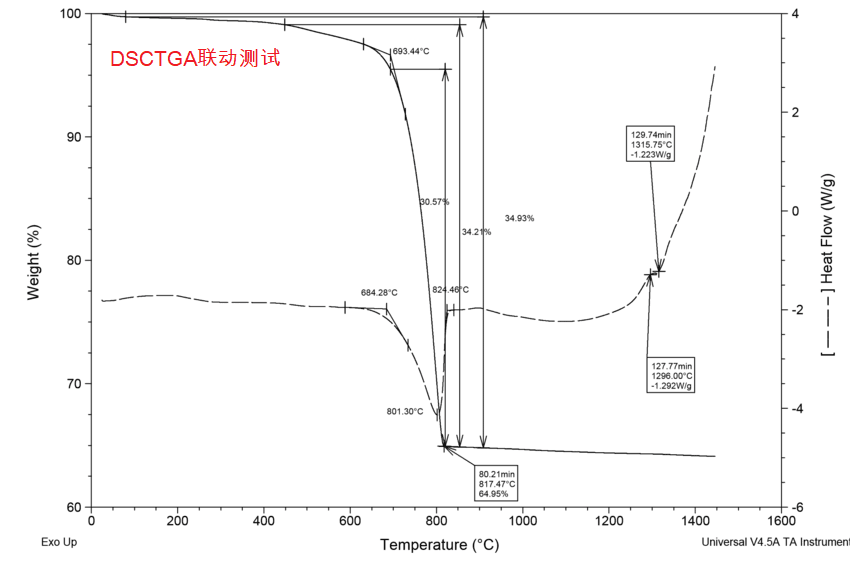
Shanghai Jituo Material Technology Co., Ltd. provides professional DSC/TGA Simultaneous Thermal Analysis (STA) testing services for polymer materials, chemical materials, inorganic ceramics, metals, composite materials, specialty chemicals and biomaterials.
DSC/TGA simultaneous thermal analysis combines Thermogravimetric Analysis (TGA) and Differential Scanning Calorimetry (DSC) in one measurement system. Under programmed temperature conditions, the instrument simultaneously records sample mass changes and heat flow. By correlating TG and DSC data obtained from the same specimen under the same temperature program, researchers can investigate the relationship between weight loss and endothermic or exothermic events.This technique supports the evaluation of thermal stability, thermal decomposition, volatile components, thermal reactions and residual mass characteristics.
1. Overview of DSC/TGA Simultaneous Thermal Analysis Services
DSC/TGA simultaneous thermal analysis combines thermogravimetric analysis and differential scanning calorimetry. Compared with performing TGA or DSC separately, simultaneous analysis provides mass-change and heat-flow information within the same experiment, making it easier to investigate whether a weight-loss event is associated with an endothermic or exothermic effect.
Main DSC/TGA testing services at Jituo Tech include:
| Testing Item | Main Measurement | Typical Application Value |
|---|---|---|
| Thermogravimetric Analysis (TG) | Sample mass changes as a function of temperature or time | Evaluation of thermal stability, weight loss and residual mass |
| Derivative Thermogravimetry (DTG) | Rate of mass change and weight-loss peaks | Identification of decomposition stages and characteristic temperatures |
| Differential Scanning Calorimetry (DSC) | Heat-flow changes | Analysis of endothermic, exothermic and thermal transition events |
| Thermal Decomposition Analysis | Weight-loss stages and thermal effects | Investigation of decomposition processes and thermal reactions |
| Thermal Stability Analysis | Onset of weight loss, decomposition stages and residual mass | Evaluation of material heat resistance |
| Volatile and Moisture-Related Analysis | Mass loss during heating | Investigation of volatile components and dehydration behavior |
| Residual Mass Analysis | Remaining mass after testing | Evaluation of inorganic residue and ash-related characteristics |
| Thermal Reaction Analysis | Heat-flow peaks and associated temperatures | Investigation of thermal reactions and transitions |
The parameters available for analysis depend on sample properties, testing atmosphere, temperature program, crucible type and data-processing methods.
DSC/TGA testing services are suitable for:
- Polymer and plastics manufacturers
- Rubber and elastomer manufacturers
- Chemical raw material and specialty chemical companies
- Inorganic ceramic, mineral and powder material developers
- Metal and composite material R&D teams
- Coating, adhesive, resin and functional material manufacturers
- Universities and research institutes
- Corporate R&D, process engineering and QA/QC departments
2. What Is DSC/TGA Simultaneous Thermal Analysis?
DSC/TGA simultaneous thermal analysis, also known as TG-DSC or STA, is a thermal analysis technique that integrates Thermogravimetric Analysis (TGA) and Differential Scanning Calorimetry (DSC) into one instrument.
- TGA (Thermogravimetric Analysis): Measures sample mass changes as a function of temperature or time. It is used to investigate weight loss, volatilization, dehydration, thermal decomposition and residual mass.
- DSC (Differential Scanning Calorimetry): Measures the heat-flow difference between a sample and a reference, providing information about endothermic, exothermic and related thermal events.
- DTG (Derivative Thermogravimetry): The first derivative of the TG curve, showing the rate of mass change and helping identify different weight-loss stages.
2.1 Working Principle of DSC/TGA Simultaneous Testing
During testing, a sample is heated, cooled or maintained at a constant temperature according to a predefined program. As the temperature changes, the sample may undergo moisture or solvent evaporation, component decomposition, oxidation, thermal transitions or other physical and chemical changes.
The instrument simultaneously records:
- Sample mass changes (TG curve).
- Rate of mass change (DTG curve).
- Heat-flow changes (DSC curve).
Correlating these curves helps identify whether an event within a specific temperature range is associated with dehydration, volatilization, thermal decomposition, oxidation or another thermal effect. The actual reaction mechanism should be confirmed by considering sample composition, testing atmosphere and, where necessary, complementary analytical techniques.
2.2 TG Curve: Mass Change Analysis
The TG curve shows sample mass changes as a function of temperature or time. It is commonly used to investigate:
- Moisture and volatile component loss
- Solvent and low-molecular-weight component evaporation
- Thermal decomposition of polymers and organic components
- Mass gain or loss during oxidation
- Dehydration, dehydroxylation and decomposition of inorganic materials
- Residual mass after high-temperature treatment
2.3 DTG Curve: Weight-Loss Rate Analysis
The DTG curve is the first derivative of the TG curve and shows how the rate of mass change varies with temperature.
DTG peaks are commonly used to identify major weight-loss stages and their characteristic temperatures. For materials containing multiple components or undergoing multi-stage decomposition, DTG analysis helps distinguish overlapping weight-loss processes.
2.4 DSC Curve: Heat-Flow Analysis
The DSC curve reflects thermal effects occurring during a temperature program. It can be used to investigate:
- Melting and crystallization-related thermal events
- Heat-capacity changes associated with glass transition
- Curing and other exothermic reactions
- Thermal effects associated with decomposition and oxidation
- Endothermic and exothermic behavior within specific temperature ranges
The DSC signal in simultaneous thermal analysis can be affected by testing atmosphere, crucible type, heating rate, sample quantity and instrument configuration. Interpretation should therefore be based on the actual experimental conditions.
3. What Properties Can Be Measured by DSC/TGA? Typical Applications
DSC/TGA simultaneous thermal analysis is suitable for applications requiring both mass-change and heat-flow information. By correlating TG, DTG and DSC curves, materials can be evaluated in terms of thermal stability, decomposition, component changes and thermal reactions.
| Property | Main Data | Typical Applications |
|---|---|---|
| Thermal Stability | Onset of weight loss, decomposition stages and residual mass | Comparison of thermal stability among materials and formulations |
| Thermal Decomposition | TG and DTG weight-loss stages and characteristic temperatures | Investigation of polymer, resin and organic material decomposition |
| Thermal Reaction Behavior | DSC endothermic and exothermic peaks | Analysis of oxidation, reactions and other thermal effects |
| Volatilization and Dehydration | Low-temperature weight loss and related heat-flow signals | Investigation of moisture, solvents and volatile components |
| Residual Mass | Remaining mass after high-temperature testing | Evaluation of inorganic residue and ash-related characteristics |
| Composition Changes | Stepwise weight loss and residual proportions | Investigation of organic and inorganic component behavior |
| Thermal Transitions | Characteristic changes in heat-flow curves | Investigation of melting, crystallization and other thermal transitions |
| Thermal Oxidation | Mass and heat-flow changes under oxidative atmospheres | Evaluation of oxidation behavior and thermal-oxidative stability |
Typical Application 1: Thermal Stability and Decomposition Analysis of Polymers and Plastics
For PE, PP, PVC, PET, PA, PC and other polymer materials, TG and DTG curves can be used to analyze weight-loss behavior, major decomposition stages and high-temperature residual mass. DSC curves provide additional information about associated thermal effects.
Typical testing objectives:
- Compare the thermal stability of different polymers or formulations.
- Investigate the decomposition stages of materials during heating.
- Evaluate the effects of fillers, flame retardants and other additives on thermal behavior.
- Provide reference data for material processing temperatures and thermal service conditions.
Typical Application 2: Composition and Thermal Decomposition Analysis of Rubber and Elastomers
Rubber materials generally contain polymer matrices, plasticizers, carbon black, inorganic fillers and other additives. Thermogravimetric analysis can help investigate formulation-related composition changes by evaluating the thermal decomposition and residual characteristics of different components.
Typical testing objectives:
- Investigate stepwise weight-loss behavior of rubber samples.
- Evaluate thermal characteristics associated with organic components, carbon black and inorganic residues.
- Compare thermal behavior among rubber formulations or production batches.
- Support rubber formulation optimization and quality control.
Typical Application 3: Thermal Behavior Analysis of Inorganic Ceramics and Minerals
For ceramic powders, minerals, inorganic salts and related materials, DSC/TGA can investigate mass changes and thermal effects during heating.
Typical testing objectives:
- Analyze weight loss associated with adsorbed water, crystal water and hydroxyl groups.
- Investigate thermal decomposition of carbonates, hydroxides and other components.
- Observe thermal effects associated with high-temperature reactions or phase transitions.
- Evaluate residual mass after high-temperature treatment.
Typical Application 4: Thermal Stability Analysis of Composite and Filled Materials
For resin-based composites, carbon fiber composites, glass fiber composites and polymer materials containing inorganic fillers, simultaneous thermal analysis can investigate matrix decomposition, additive volatilization and high-temperature residue characteristics.
Typical testing objectives:
- Compare the thermal stability of different composite systems.
- Analyze thermal decomposition of polymer matrices.
- Investigate inorganic components and residual mass.
- Support evaluation of the effects of filler content on thermal behavior.
Typical Application 5: Thermal Behavior Analysis of Specialty Chemicals and Biomaterials
For specialty chemicals, pharmaceutical-related materials and bio-based materials suitable for thermal analysis, TG and DSC signals can be used to investigate mass changes and thermal effects during heating.
Typical testing objectives:
- Analyze moisture, solvents and volatile components.
- Investigate thermal decomposition and thermal stability.
- Observe dehydration, melting and other thermal events.
- Support formulation screening, storage-condition evaluation and process research.
4. Which Materials Can Be Tested by DSC/TGA?
DSC/TGA simultaneous thermal analysis can be applied to a wide range of solid and liquid samples. Feasibility depends on thermal stability, volatility, reactivity, testing atmosphere, crucible compatibility and high-temperature safety.
| Material Category | Typical Materials | Main Testing Objectives |
|---|---|---|
| Polymers and Plastics | PE, PP, PVC, PET, PA and PC | Thermal stability, decomposition, weight loss and residual mass |
| Rubber and Elastomers | Natural rubber, nitrile rubber, silicone rubber and EPDM | Decomposition stages, composition changes and residue characteristics |
| Resins and Adhesives | Epoxy, phenolic and polyurethane resins, adhesives | Thermal decomposition, volatile components and thermal reactions |
| Chemical Materials | Organic chemical raw materials, functional additives and polymer additives | Thermal stability, volatilization and thermal reactions |
| Inorganic Ceramics | Oxide ceramics, ceramic powders and sintering raw materials | Dehydration, decomposition, thermal reactions and residual mass |
| Minerals and Inorganic Salts | Carbonates, hydroxides, silicates and related minerals | Crystal water, dehydroxylation and thermal decomposition |
| Metals and Alloys | Selected metals, alloys and surface-treated materials suitable for thermal analysis | Oxidation, mass changes and thermal reactions |
| Composite Materials | Carbon fiber, glass fiber and resin-based composites | Matrix decomposition, filler behavior and residual mass |
| Specialty Chemicals | Solid or liquid chemicals suitable for thermal analysis | Volatilization, decomposition and thermal stability |
| Biomaterials | Selected bio-based materials and related polymers | Moisture loss, thermal decomposition and thermal behavior |
Important sample considerations:
- Samples must not explode within the intended testing temperature range.
- Samples must not generate unassessed highly toxic or severely corrosive gases during testing.
- Samples should not contain undisclosed low-boiling-point solvents or water. Special samples require prior evaluation.
- Samples that are volatile, oxidation-sensitive, reactive or potentially incompatible with the crucible require preliminary feasibility assessment.
- Suitable crucibles and testing atmospheres should be selected according to the properties of metal, ceramic and inorganic powder samples.
- For samples with unknown compositions, provide available safety information and known component details before high-temperature testing.
5. DSC/TGA Instrument Model
Instrument Model: Mettler-Toledo TGA/DSC 1
Shanghai Jituo Material Technology uses a Mettler-Toledo TGA/DSC 1 simultaneous thermal analyzer for DSC/TGA testing.
The system integrates thermogravimetric and differential scanning calorimetric measurements, allowing sample mass changes and heat-flow signals to be collected simultaneously under the same testing program.
Testing programs, temperature ranges and experimental conditions can be developed according to sample properties and research objectives, supporting thermal stability, decomposition, volatilization and residual mass analysis.
6. DSC/TGA Instrument Technical Specifications
According to the specifications published on the current Shanghai Jituo service page, the instrument parameters are as follows:
| Technical Parameter | Published Specification |
|---|---|
| Instrument Model | Mettler-Toledo TGA/DSC 1 |
| Temperature Range | Room temperature to 1400°C |
| Temperature Accuracy | ±0.01°C |
| Heating Rate | 0.1–100°C/min |
| Measurement Signals | Simultaneous TG mass-change and DSC heat-flow acquisition |
Specification note: The values above are taken from the existing service page. Actual operating ranges and performance specifications may depend on instrument configuration, furnace and sensor components. Before publication, the laboratory should verify the temperature range and the definition of temperature accuracy against the instrument configuration and calibration documentation.
7. DSC/TGA Sample Requirements
Both solid and liquid samples can be submitted. The recommended sample quantity is 20–100 mg, packaged in a plastic centrifuge tube. |:---|:---| | Sample State | Solid or liquid | | Recommended Sample Quantity | 20–100 mg | | Packaging | Plastic centrifuge tube | | Volatility | Samples should not contain undisclosed low-boiling-point solvents or water | | Thermal Safety | Samples must not explode within the testing temperature range | | Gas Safety | Samples must not generate unassessed highly toxic gases |
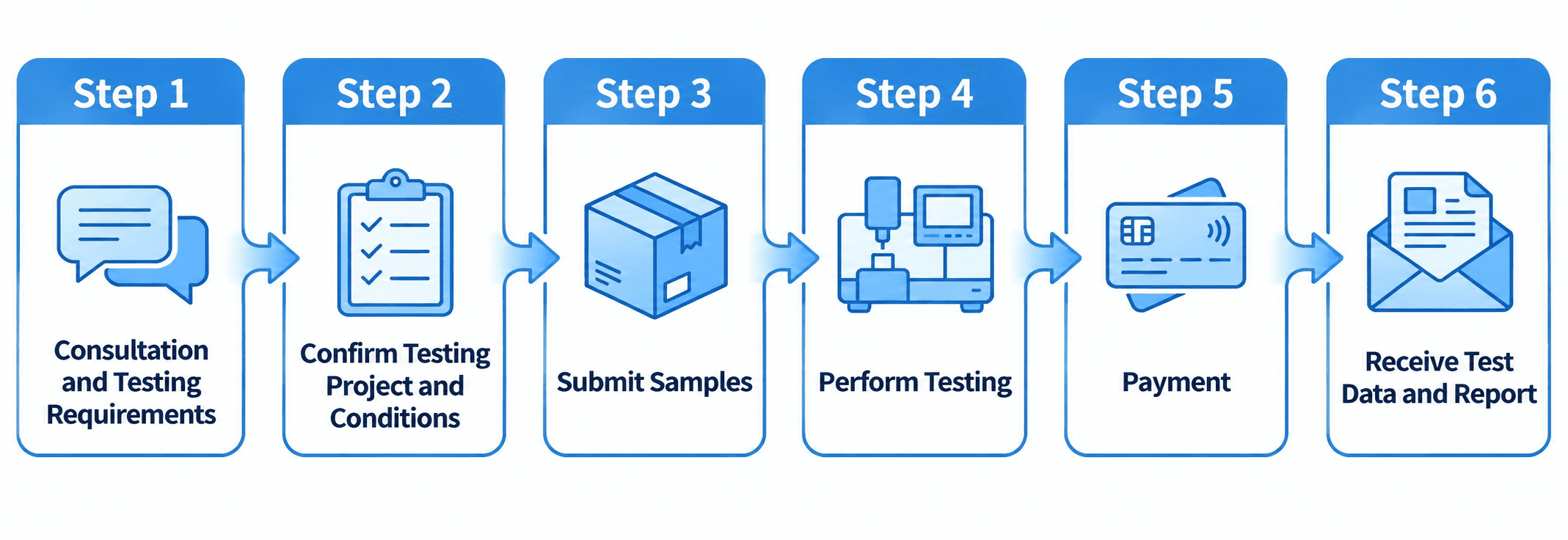
8. DSC/TGA Testing Procedure
9. DSC/TGA Testing Standards
The selection of DSC/TGA testing standards depends on material type, testing objectives and the actual measurement method. Standards for TGA composition analysis, DSC glass transition determination and simultaneous thermal analysis are not interchangeable. The fact that an instrument collects both TG and DSC signals does not mean that every single-technique standard can automatically be applied to the combined test.
| Standard | Standard Name or Application | Main Purpose |
|---|---|---|
| ASTM D6370-23 | Rubber—Compositional Analysis by Thermogravimetry (TGA) | Determines organic matter, polymer, carbon black and ash in rubber compounds using TGA |
| ASTM D7426-24 | Assignment of the DSC Procedure for Determining Tg of a Polymer or an Elastomeric Compound | Determines the glass transition temperature of polymers or elastomeric compounds using DSC |
| ISO 11358-1 | Plastics—Thermogravimetry (TG) of polymers—General principles | General principles for thermogravimetric analysis of polymers; verify the applicable current edition |
Standards clarification:
- ASTM D6370-23 is a thermogravimetric method for rubber composition analysis, focusing on organic materials, polymers, carbon black and ash.
- ASTM D7426-24 is a DSC method for determining the glass transition temperature of polymers or elastomeric compounds. It is not a DSC-TGA simultaneous method for determining polymer/filler ratios in rubber.
- ISO 11358-1 may be considered as a reference for polymer thermogravimetric analysis. Its current edition and applicability should be verified before use.
- The final testing standard should be confirmed according to sample type, testing objectives, instrument configuration and customer requirements.
10. DSC/TGA vs. Other Thermal Analysis Techniques
DSC, TGA, DSC/TGA simultaneous thermal analysis, DMA and TMA are commonly used thermal analysis techniques. However, they differ in measurement principles and applications.
| Instrument | Full Name | Core Measurement | Main Applications |
|---|---|---|---|
| DSC | Differential Scanning Calorimeter | Heat-flow changes | Tg, melting, crystallization, curing and thermal effects |
| TGA | Thermogravimetric Analyzer | Mass changes as a function of temperature or time | Thermal stability, decomposition, volatiles and residual mass |
| DSC/TGA (STA) | Simultaneous Thermal Analyzer | Simultaneous mass-change and heat-flow measurement | Correlation of weight-loss processes and thermal effects |
| DMA | Dynamic Mechanical Analyzer | Storage modulus, loss modulus and Tan Delta | Viscoelasticity, dynamic modulus and damping |
| TMA | Thermomechanical Analyzer | Dimensional changes or deformation under temperature variation | Thermal expansion, softening and dimensional stability |
What Is the Difference Between DSC/TGA and DSC?
DSC primarily measures the heat-flow difference between a sample and a reference. It is used to investigate glass transition, melting, crystallization and curing-related thermal events.DSC test
What Is the Difference Between DSC/TGA and TGA?
TGA focuses on sample mass changes as a function of temperature or time. It is commonly used for thermal stability, weight-loss stages and residual mass analysis.TGA test
What Is the Difference Between DSC/TGA and DMA?
DMA measures the mechanical response of materials under periodic dynamic loading. It provides parameters such as storage modulus, loss modulus and Tan Delta for evaluating viscoelasticity and damping performance.DMA test
What Is the Difference Between DSC/TGA and TMA?
TMA measures dimensional changes or deformation under a controlled temperature program and applied load. It is used to evaluate thermal expansion, softening and dimensional stability.TMA test
DSC/TGA primarily focuses on mass changes and heat-flow changes. The two techniques serve different measurement purposes.
11. DSC/TGA Testing Cases
Case disclosure note: The current Shanghai Jituo DSC/TGA service page publicly displays one DSC-TGA testing graph, but does not provide the sample name, complete experimental conditions or original test report. Case 1 below is based on the publicly displayed graph. Cases 2 and 3 are structured case templates that require actual project records before publication. They should not be presented as completed customer cases without verified experimental data.
Case 1: High-Temperature DSC/TGA Simultaneous Analysis – Publicly Displayed Graph
Test Object:
The sample represented in the DSC-TGA simultaneous testing graph published on Shanghai Jituo's existing service page. The specific sample name, customer information and chemical composition are not disclosed.
Testing Objectives:
- Observe sample mass changes under high-temperature conditions.
- Analyze major weight-loss stages and corresponding characteristic temperatures.
- Investigate high-temperature thermal effects using the DSC heat-flow signal.
- Evaluate residual mass characteristics after testing.
Testing Method:
DSC/TGA simultaneous thermal analysis was used to collect TG mass-change and DSC heat-flow signals under programmed temperature conditions. The TG data were used to analyze the weight-loss stages.
The publicly displayed graph extends into a high-temperature range. The specific heating rate, testing atmosphere, sample quantity and crucible type are not disclosed on the page.
Data and Curves Obtained:
- TG mass-change curve.
- DSC heat-flow curve.
- Major weight-loss stages and marked characteristic temperatures.
- High-temperature heat-flow features.
- Residual mass information after testing.
The publicly displayed graph contains visible temperature labels at approximately 684.28°C, 693.44°C, 801.30°C, 817.47°C and 824.46°C. It also shows a weight-loss-related annotation of approximately 34.93%. Additional heat-flow feature labels appear in the high-temperature region around 1296–1315.75°C.
These values are visual annotations from the published image. They have not been independently recalculated or verified against the original raw data. Their precise physical interpretation should be confirmed using the original test report, curve direction and experimental conditions.
Application Value:
Correlating TG and DSC curves helps investigate weight-loss stages, thermal effects and residual mass characteristics of high-temperature materials, supporting thermal stability evaluation and high-temperature process research.
Case 2: Polymer, Carbon Black and Inorganic Filler Analysis in Rubber – Actual Project Data Required
Test Object:
A rubber sample from an actual testing project, such as natural rubber, nitrile rubber, EPDM or another rubber formulation. The specific sample name and formulation should be based on the actual project record.
Testing Objectives:
- Investigate sample mass loss across different temperature ranges.
- Analyze the thermal behavior of organic components, polymers, carbon black and inorganic residues.
- Compare composition-related thermal behavior among different rubber formulations or batches.
- Support rubber formulation optimization and quality control.
Testing Method:
A thermogravimetric testing program is developed according to the rubber composition and testing objectives. Where appropriate, different testing atmospheres and stepwise temperature programs may be used. TG, DTG and DSC curves are analyzed together when simultaneous data acquisition is included in the project.
For rubber composition analysis under an applicable standard, the types of fillers and their thermal decomposition behavior must be considered. Filler-related mass loss should not be misinterpreted as a change in polymer content.
Data and Curves to Include:
- TG mass-change curve.
- DTG weight-loss rate curve.
- DSC heat-flow curve, if simultaneous acquisition is included.
- Stepwise weight-loss percentages and characteristic temperatures.
- High-temperature residual mass and related analysis.
- Comparison data among formulations or samples, if available.
Application Value:
Analyzing stepwise weight loss and residual mass can help investigate rubber formulation composition and differences in thermal behavior among production batches.
Information Required Before Publication: Actual sample name, test date or project identifier, testing atmosphere, temperature program, sample quantity, crucible type, original curves and verified analytical results.
Case 3: Thermal Decomposition and Residual Mass Analysis of Inorganic Ceramic or Mineral Materials – Actual Project Data Required
Test Object:
A ceramic powder, mineral powder, inorganic salt or other inorganic material from an actual testing project. The specific sample name should be taken from the original testing record.
Testing Objectives:
- Analyze sample mass changes during heating.
- Investigate weight loss associated with crystal water, adsorbed water or hydroxyl groups.
- Observe thermal decomposition of inorganic components and related thermal effects.
- Evaluate residual mass after high-temperature treatment.
Testing Method:
A testing program is developed according to sample composition, thermal stability and crucible compatibility. TG and DSC signals are collected simultaneously under programmed temperature conditions, with DTG analysis used to identify different weight-loss stages.
For samples that may undergo oxidation, reduction or reactions with the crucible, the testing atmosphere and crucible material should be confirmed in advance.
Data and Curves to Include:
- TG mass-change curve.
- DTG weight-loss rate curve.
- DSC heat-flow curve.
- Major weight-loss stages and corresponding characteristic temperatures.
- High-temperature residual mass.
- Thermal effect analysis across different temperature ranges.
Application Value:
Simultaneous analysis of mass changes and heat-flow changes can help investigate dehydration, decomposition and high-temperature behavior of inorganic materials, supporting ceramic raw material screening, thermal treatment development and material formulation research.
12. Frequently Asked Questions About DSC/TGA Testing
FAQ 1: What Can DSC/TGA Simultaneous Thermal Analysis Measure? What Are Its Advantages Over Separate DSC or TGA Testing?
DSC/TGA simultaneous thermal analysis collects sample mass-change and heat-flow information within the same experiment. It is used to investigate thermal stability, thermal decomposition, stepwise weight loss, volatile components, residual mass and associated endothermic or exothermic behavior.
Compared with standalone TGA, it provides additional heat-flow information. Compared with standalone DSC, it provides additional mass-change information. It is particularly useful when the research objective requires correlation between weight-loss processes and thermal effects.
FAQ 2: How Much Sample Is Required for DSC/TGA Testing? How Should Samples Be Packaged?
According to the current Shanghai Jituo service page, the recommended sample quantity is 20–100 mg. Both solid and liquid samples can be submitted in plastic centrifuge tubes.
The actual sample quantity should be confirmed according to sample homogeneity, volatility, reactivity and testing objectives. Please disclose any moisture, low-boiling-point solvents or other volatile components before sample submission.
FAQ 3: Which Materials Can Be Tested by DSC/TGA? Can Powders, Liquids, Ceramics and Metals Be Tested?
DSC/TGA can be used for various solid and liquid samples. Polymers, rubber, resins, inorganic ceramics, minerals, metals and composite materials may be suitable, depending on their thermal stability, volatility, reactivity and crucible compatibility.
For powder, liquid, oxidation-sensitive or potentially hazardous samples, please provide composition and safety information in advance so the laboratory can assess testing feasibility.
FAQ 4: Can DSC/TGA Determine Thermal Decomposition Temperature, Ash Content and Filler Content?
TG and DTG curves can be used to analyze weight-loss stages, characteristic temperatures and residual mass. For selected rubber and polymer formulations, applicable testing standards and known composition information can help evaluate organic components, polymers, carbon black and inorganic residues.However, residual mass is not necessarily equivalent to ash or filler content. If fillers themselves decompose or undergo mass changes within the testing temperature range, their chemical composition, testing atmosphere and temperature program must be considered for correction or further analysis.
FAQ 5: What Is Included in a DSC/TGA Testing Report? How Long Does Testing Take?
Depending on the agreed testing scope, a report may include sample information, instrument information, testing conditions, TG curves, DSC curves, DTG curves where applicable, characteristic temperatures, weight-loss stages, residual mass and relevant analytical comments.


